Thursday, July 14, 2011

THE FLOTSAM AND JETSAM


(Right) Okara's THE VOICE

By Omoseye Bolaji

“The people who have the sweetest insides are the think-nothing people
and we here try to be like them. Like logs in the river we float and
go whither the current commands and nothing enters our insides to turn
the sweetness into bitterness,”


- from Gabriel Okara’s THE VOICE


When Pa Okara published his novel – THE VOICE – decades ago many critics and
reviewers interpreted the work as one exhorting, calling for moral
regeneration in African societies generally.

In the haunting book (The Voice) Okolo, the protagonist is on a
puzzling, nigh esoteric quest for “it” – loosely defined as “meaning
of life”; advising his people and others to ponder about the lives
they are living, their integrity, purpose of existence etc.
Ultimately, Okolo pays the price for his “treachery” and is killed on
the orders of King Izongo.

It is stressed again and again that most people will rather live
“empty” lives, lives without a purpose, and they would not like others
criticising them or calling for more integrity from them. Remarkably,
the book was published over forty years ago; yet its theme still
resonates till date.

Has Africa moved forward since the book was published? Not even an
obtuse optimist would say “yes”; the whole continent has been ravaged
with a plethora of negative things – including extraordinary
corruption, civil wars, maladministration, greed, diseases (not
forgetting the scourge of hiv aids), famine etc.

On an individual level, the type of people referred to as those who
are “like logs in the river we float and go whither the current
commands and nothing enters our insides to turn the sweetness into
bitterness” seem to proliferate in African nations, including in
Nigeria and South Africa. Yet it might well be a cosmetic situation.
But how do they manifest themselves? Do they really do any harm?

Here in South Africa, you see a medley of people milling around
apparently jobless and purposeless, wallowing in the same. Young and
old. You see them hanging around their houses, their neighbourhood,
nearby taverns and shebeens. You see a few of them and you’ve seen
them all…

Yet paradoxically, there is a serenity that surrounds people of this
ilk that indeed gives the impression that “the people with the
sweetest insides....” A friend of mine in South Africa once called
them the “flotsams and jetsam,” During summer, winter – never mind
autumn and spring – they are in profusion; often friendly, waving,
greeting good-natured in their apparent vacuousness.

Do these people have any real ambitions? What do they think about life
itself? Do they have plans to forge ahead in life? What do they do by
way of finding jobs, or furthering their education? These are answers
for the pertinent pundits and experts, perhaps. On a simplistic
level, what is clear enough is that they remind one of Okara’s famous
description.

Nor should we be naïve enough to think that many of these people are
as harmless as they look. From among their ranks the likes of thieves,
rapists, even murderers lurk. Perhaps this is in accordance with the
hoary saying that “an idle mind is the devil’s workshop,”

Sunday, July 3, 2011

OMOSEYE BOLAJI'S LATEST BOOK (2011)


OMOSEYE BOLAJI'S LATEST BOOK (2011)

Review by Paul Lothane


So Omoseye Bolaji’s 2011 book is out, and those of us who love his brand of writing are enthused again. After all, his last book came out in very early 2010. The new book is titled Miscellaneous Writings.

Some might be disappointed that the new work is NOT fiction. But as I always say, we can always re-read Bolaji’s many works of fiction anyway. This latest work comprises short essays, articles, reviews etc, written by the author.

As the blurb of the book tells us: “This book contains a selection of (Bolaji’s) miscellaneous writing: brief, informative, sparkling, introspective; often humorous and dazzling. Not surprisingly, the author touches on many aspects of the world of literature…”

This book is written in various styles, so to speak. I suppose the author wrote each piece the manner in which he felt they should be written. Bolaji’s essays on writers D.H Lawrence, NMM Duman, and (largely) Lewis Nkosi are essentially formal, with a rather disciplined format.

Yet there are idiosyncratic pieces included in this new work too, as one would expect from Bolaji. The write-up on “facebook” will probably fall under this framework; as would the one titled “The vagaries of poverty”, and “Guitarists with brio”. Read them and see whether you agree with me!

A few of the essays in this new book clearly show Bolaji’s passion for sports, especially football. The one on “Segun Odegbami” a former great African soccer player, is filled with child-like fascination and hero-worship, for example. Odegbami was at his best when the author was still quite young.

Yet by the time the 2010 World Cup finals came around, Bolaji, as a grown-up, exhibits the same passion for football, but is much more philosophical and serious about it all. Hence the three or so special articles pertaining to the unforgettable South Africa 2010 in this book, reaching a peak with the one titled “The allure of the stadium”

It is no surprise – since Bolaji is such a fine writer of fiction – that some of the essays here seem almost as if we are reading short stories. Examples in this wise here are “Gem of an artist”, “The burgeoning wordsmith”, “Stumped”, “The pungent illustrators", and “Murder in the temple”

Bolaji is also famed for the twists and turns of his fiction, the unexpected conclusions. We see traces of this here in some of these short essays, especially “Stumped”. Can a leopard change its spots?

In the very last segment of this new book, some recent essays on Bolaji’s literary work are published. The piece on his short stories (The Guillotine), is excellent; as are essays written by Deon Simphiwe Skade and Raphael Mokoena. I agree with Pule Lechesa, who wrote the Introduction to this book, that all lovers of literature in particular must get a copy of Omoseye Bolaji’s “Miscellaneous Writings”.

Those interested in getting a copy of this new book can email barbara@newvoices.co.za

Thursday, June 30, 2011

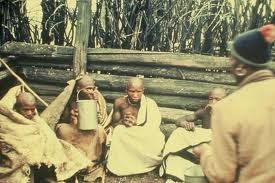
THE PROFUNDITIES OF INITIATION?


By Omoseye Bolaji

It was a magnanimous gesture on the part of Ntate Thabo, the nigh-veteran South African police officer. Although exactly 50 years of age now, he has been in service for decades.

Now, he painstakingly tracked me down to buy me special lunch!I had been rather busy and could not meet him for a couple of days. He kept on phoning me. “My friend, stop avoiding me,” he said. “I have some extra money now, and I want to make you happy....” Anyway I did meet him, and we went for some drinks – and a magnificent lunch, at his expense.

We talked. A very hearty straightforward, genial man, this man is a mine of so many intriguing stories. He has had a somewhat checkered career while serving his country, but at least he is very much a fulfilled man in his own right. This became evident as he told me about his son. Thabo grinned. He does have a wonderful smile!

“Ah, my son – in his early 20’s – will soon become a man. You know, he will be spending weeks at the arcane initiation centre, up in the mountains; where he’ll be circumcised during this winter. I’ll be driving my boy there,” he said.

I winced. Initiation ceremonies have become somewhat controversial in South Africa these days, with horrifying tales of kids being abducted, suffering harrowingly, bleeding to death during these initiation ceremonies. And here was a proud father, who will soon drive his own son there very much willingly.

Officer Thabo was still smiling. “Thank God, my boy will soon become a veritable man. I’ll be supporting him all the way whilst he’s there (in the mountains); taking food and other material support to him; blankets....”

I managed to say: “you mean, you are not worried...about your son. I have read so many negative things about these initiations...the practice is not anachronistic?"

Whether he understood what I meant by “anachronistic" I am not sure; but he continued smiling effulgently. He said: “My son knows that without going through the initiation rites he would not be regarded as a true man in many circles as he grows up. That is why you see some very old men in my culture (the South African Xhosa people) going to the initiation schools in the end...."

My mind went briefly to Camara Laye’s masterpiece, ‘The African Child’, which brilliantly re-creates the poignant ambience, fear, dread, pains, and travails of such initiations in his own old society (Guinea). I suppose there is a lot to be said for Africans still having pride in certain ancestral customs.

“What are you thinking? Still worried about the initiation? I’m the boy’s father, and I’m not worried. Why should you?" my cop friend said, still good naturedly.I said: “You know, I’ve always felt that maybe some sort of printed certificate should be given out at these initiation schools, maybe as a token to modernity. I mean; all those weeks of deprivation, great discipline, learning, learning, the old ways...."

Thabo laughed. “There is no need for any certificate. There are special songs they learn at the initiation, which nobody else can know. The uninitiated cannot pretend to have gone to the school....Stop worrying about nothing. Let me get you another drink, my friend," he added, still with sparkling good humour.

-------------------------------------------------------------------------------------

This piece, in its original form, sparked some interest and comments. I was particularly interested in the comments of my good friend, Soqaga "Dada", a very proud Xhosa man who commented thus:

"You must also know that we the Xhosas we are
unshaken and unafraid to practice our ancient culture of initiation.
It is the old culture and since this western and so called advanced super
power states have problem about it and certainly we cannot compromise
our noble,lovely and beautiful heritage of our forefathers. This is
the best school for the boys to learn to behave in a manner that is
moral and disciplined in our society..."

Thursday, June 16, 2011

"ND" AND THE INTERNET

By Omoseye Bolaji

It was “peak period” inside the internet centre, as it were. A cauldron of frenetic activities! Here we were in the heart of Bloemfontein city in one of the internet cafes.

As usual the young ones, the students, were in the majority here now, adolescent boys and girls in school uniform chatting and gossiping whilst savouring the wonders of the internet. Eyes glued on the screen of the computers; intermittently the young ladies in particular checked the latest goings-on on facebook – both on the computer screens and their mobile phones.

Apparently, these days the young find it much easier doing their homework and assignments with the help of the internet. Showing off their knowledge, the pupils luridly made suggestions to each other: “No, try Google!” “Wikipedia is better!” “I still like yahoo,” etc.

I could hardly hide my smiles; perhaps I was in a tolerant mood! But it struck me powerfully how the youth have taken all these scientific marvels in their stride; how they take it all for granted. Whilst the truth is that the world has existed for thousands of years, yet incredibly things like world wide web, internet are just about 20 years old in human existence!

Now virtually everybody, especially the youth take advantage of this technology every time, sending a plethora of electronic messages hither and thither; be it via emails, facebook, twitter, SMS (text messages) etc. I shook my head, remembering that not so many years ago – before the internet became popular in Africa too – as a roving journalist I used to send my reports via telephone (eg from stadia during football or rugby matches), as internet was very scarce then.

“ND”- the owner of the internet cafe now entered, surveying the goings-on inside his internet cafe. He greeted me very well – after all we are both Nigerians and have been friends for years and he moved on to his office.Ah, ND! A very important man indeed, though the hordes of youngsters here at his internet cafe would not know this.

ND, a proud Igbo man to boot, was the first person to popularise the internet in the whole of Bloemfontein city. Almost 10 years ago he opened his internet café and charged incredibly cheap prices for the masses” to come and use his services. To complement this, he went out of his way to teach people the wonders of the internet at a time ignorance was rife in this wise even amongst the most educated people.

Within a few years other people were copying the pioneering efforts of ND, all over the city; opening internet cafes and trying to keep the prices down. Gone now were the days when black people in particular had to more or less “travel” to white areas to use the internet at very exorbitant rates. That was/is the legacy of ND!

And he was not alone. In other South African cities (and towns), Nigerians over the last 10 years have contributed greatly to popularising the internet – in well known cities like Johannesburg, Cape Town, Pretoria, for example. Till date, many of such internet cafes belong to Nigerians; affording cheap access to the internet for large numbers of people; and to boot, often opening their offices to the public at unusual times (eg late into the evening, and on Sundays.

Hence we now see a situation where hordes of people, including young scholars, flood these internet cafes. Yes they are taking so much for granted; but that is part of the effervescence of youth. They take it all in their stride!

Wednesday, June 1, 2011

RASPUTIN!


By Omoseye Bolaji

“There lived a certain man in Russia long ago
He was big and strong, in his eyes a flaming glow.
Many looked at him with terror and with fear
but to Moscow chicks he was such a lovely dear…”


From Boney M’s hit, Rasputin.

I was with a white friend or acquaintance, of mine in the South African suburbs. I seldom went to his place and whenever I did, I initially had to jump through hoops of the intimidating presence of his dog (in the courtyard)! But here we were now, in the sitting room.

It was, I suppose, an average sitting room. A big television set, sound system, an impressive library to my left; and the inevitable laptop on the table. Some sofas were dotted around in the room. David (that’s his name), after giving me a drink, said he wanted to play some music.

“I suppose you won’t appreciate the music, though it’s English” he said. “One of my old favourites. It’s Boney M, You know the old group?”I nodded absent-mindedly; my mind was engaged on something else for a moment.

Then I found myself almost freezing, goose pimples coursing through me! All because of the music of Boney M, David was now playing! It was “Rasputin," and its “bizarre” melody and lyrics were affecting me adversely! It was as if I was about to faint!

“What’s going on Bolaji?” he said, “Have you suddenly come over a bit sick?” I forced a wry smile, trying to pull myself together.But my mind had gone back to decades ago, when I was a very young student at the university, University of Ife, Ile-Ife, in Nigeria. I stayed at Angola Hall of residence and there was a particular student in my room who used to play Boney M, especially “Rasputin" rather late in the night almost every day.

He knew by then that most of the inmates in the room did not like this particular song.I remember one of them complaining: “What the hell is this? What type of music is this? It’s like I must run to my mother for protection when I hear this song…Rasputin!”

Yet I found myself fascinated by the lyrics of the bizarre- sounding song (a great international hit decades ago, overseas). Over the years, I was to learn the real-life details of the erstwhile Soviet Union’s Rasputin even more, the gentleman who had caused a stir in Russia many years ago, garnering the reputation of becoming something of a philanderer and manipulator.

I was in Sierra Leone some years ago when I read an authoritative book on the life and times of Rasputin, written by his daughter. Thereafter, I appreciated even more the legacy of the charismatic, controversial Rasputin; and how his life and demise spawned the many legends, myths, exaggerations that still survive him (including the Boney M song on him).

Yet the killing, the murder of Rasputin, is one of the most horrific ever; if contemporary accounts can be believed; he was not only poisoned, but shot many times, stabbed, his manhood cut off, his body thrown in an icy lake etc…all these factors combined to overwhelm me when I heard the “Rasputin" song again!

I said to David now: “Don’t worry. There’s no problem. I was just carried away for a moment. I’m enjoying your drink. Thanks,” Rasputin!!!

Wednesday, May 18, 2011

THE SVELTE LADY

By Omoseye Bolaji

It had been a rather arduous day – a plethora of unexpected events had soured the day for me - and as “evening” approached, it gets dark very quickly in South Africa now because winter has more or less arrived, I wanted to leave the office and let my hair down a bit.

But I said politely enough to “Madam Maki”, the charming, amiable South African “Manager” of my Office: “Am I glad to leave the office now! I’m bushed, tired, finished,”

“Laelae!” (Never) Madam Maki said, smiling; displaying the full range of her West African vocabulary!

Anyway some time later, I was happy to relax at ATLAS where fine food and drinks are in abundance. But there was to be no peace for the wicked! (as they say) Even as I relaxed with a drink, with what I thought was a hostile, unfriendly expression etched on my face, a few people still came to me to chat intermittently.

One of them was a nice gentleman who works in the main toropo (city) library. “Hi!” he burst out. “We’ve been rather worried about you. You’ve not been to the library for quite some time now. We think it’s strange,” I stared at him.

“We?” I said “Yes my brother,” he replied. “You know people are always asking for you, you and Ntate Flaxman, Mr Lechesa, etc when they come to borrow your books from the library. Many of them are so much interested in literacy and literature and we have to tell them you’ve been ‘scarce’ at the library. I mean, a person like you has published so many books; why should you avoid the libraries?”

What type of logic was this? I wondered, still not in the best of moods. It seemed to me that the legendary Wole Soyinka would regard this type of logic as “casuistry” of the highest order! But I just nodded, muttered something and wondered whether anything could cheer me up. Meanwhile another male friend, or rather acquaintance, of mine had sat down beside me.

The librarian departed, but the acquaintance seated on my right was making “small talk,” and I listened in desultory fashion. Then he suddenly gripped my hand tightly and said: “Oh My! What a lovely lady! Look, my friend!” I stared at the entrance of the place, and a well dressed young lady, lovely to boot, was stepping inside. She had a svelte, streamlined figure. I said to the guy beside me.

“Come on, don’t be childish! There are many lovely ladies around, but it’s not our business."“ But the scamp was grinning. “She’s making a beeline towards you; she’s coming to you!” he announced. “No doubt she knows you,” I was about to say I had never seen the young lady before, but she had got to our table and in a coy way was smiling at me. Stunned, I wondered what was going on. She opened her bag and brought out a sort of exercise book. “I’m sorry if I’m embarrassing you Mr Bolaji,” she said. “I just want your autograph. I’ve read a few of your books and I loved them very much”

Maybe it’s human nature. I suddenly cheered up, whilst signing the autograph for her. The lady had somehow made me feel better; a veritable ray of sunshine!

Saturday, April 9, 2011

MALOME STUMPED!

By Omoseye Bolaji

The eatery/drinking place was almost bursting at the seams; but this did not discourage me from entering it. There were raucous and jocose conversations all around.

I looked for a spot to sit, absent-mindedly staring at the elevated TVs.
I was sure, from habit, that at the end of the cavernous place there would be some space for me. And so it turned out – to my right near the cul de sac I could see at least one table empty. But as I almost got there, there was a tug on my arm.

“Chief,” a friendly voice said. “You can take my seat. I was just leaving.” I now saw that it was an acquaintance of sorts, a man of bonhomie. I sat down where he indicated – and noticed that a young man was sitting in front of me. We nodded at each other.

I placed my order with one of the ladies working here, and waited for service. The gentleman in front of me was taking one of those cider drinks, and on my own part I was soon eating a fine plate of pap and dikgorolo cooked intestines. A lover of fine food, the gastronomic delight “went down the hatch” with alacrity! And now I could concentrate on my drink.

It was an almost awkward situation as the gentleman in front of me and I intermittently stared at each other. I do not make it a habit to be too garrulous with strangers and often leave it to the other party to start talking with me. And so it was this time.

“You don’t like talking much eh?” he said. “I have seen you in the papers many times. You write books and stuff eh?”

That was how the ice was broken. I was thinking that here was a personable young man, and we talked a bit. Presently he said: “Every now and then, I go to many places to drink and relax. Perhaps that is what happens when, like in my case, I have no partner!”

I replied: “Come on! A good looking man like you can get a lady anytime...”
A rather rueful smile from him; then he said: “Actually I’m a woman, not a man.” A pause. “You can see my ID Book to this effect...” She gave me her green ID book, and stunned, I saw that it was true! This fine young ‘man’ was actually a woman!

I began to apologise. “I’m sorry ma’am...I’m so stupid.” Like they say in cricket, I was stumped!

But she stopped me, smiling. “Ag, Ntate don’t worry. Many people do make that mistake, thinking I am a man. Even if I did my hair like a girl, I’d still look rather like a man...” She was very decent about it indeed, trying to put me at ease.

But despite her best efforts, her dignified mien, I still felt quite bad and was happy to leave that place soonest! I now realised even better the plight of the celebrated South African (female) athlete, Caster Semenya; and the furore surrounding her gender; with the strident claims in international circles that the powerfully-built young lady must be a man! Unfortunate, really…