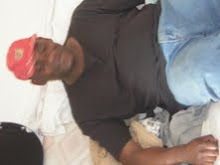
Alejo Pataki (the distinguished guest)
By OMOSEYE BOLAJI
It was a rather exciting time as Achal Prabhala, a notable international scholar and researcher, spent some days in Bloemfontein city, South Africa (where I am based), learning more about black writing at grassroots level. Flatteringly, he spent a considerable time with me.
Of course I was not the only one Achal met and probed on writing literature. He also met established writers like Flaxman Qoopane, Pule Lechesa, Hector Kunene, Nthabiseng “Jah Rose” Jafta, Raselebeli Khotseng etc. Affable, charming yet intellectually pugnacious (!), Achal was a busy bee during his visit.
On consecutive evenings/nights, I was privileged to be ensconced at the famed Mimosa Mall in Bloemfontein – sipping drinks and the like with Achal. There are many layers to this suave gentleman! This alumnus of Yale University, USA, is a consultant to the nigh-monolithic Wikipedia, an associate editor for Chimurenga, among so many other feathers in his cap.
He is also an avid reader; easily discussing classical and/or literary works of the likes of Charles Dickens, William Shakespeare, Thomas Hardy, JM Coetzee, Ngugi, Nadine Gordimer, Chinua Achebe, Tsitsi Dangarembga, Dambudzo Marechera, among many others. And as a proud Indian, he is well aware of the literary trends in his own country.
As regards Nigeria, I was pleasantly surprised to learn that the gentleman (Achal), is well aware of most of the key writers, scholars, universities and even the quality publishers. He even had quite a lot to say about my Ibadan city! I was beginning to think he was something of an “anjonnu” – a wizard!
He has a fine sense of humour too with his regular quips, anecdotes and witticisms. He told me bluntly: “I have an idea I’d have to see a psychiatrist after finishing with you!” Apparently I was sending him around the bend! I assured him it was mutual, with his scholarly pontifications.
I was also staggered with Achal’s generosity. He was ready to pay princely sums to buy certain publications (books), and in incongruous fashion, I found myself in a position where I had to be convincing him not to pay so much for certain works. He assured us that he was a most assiduous reader, who could be at ease devouring the classics and at the same time appreciating what some might dub “trashy literature.”
For me, one of the highlights of his visit was when Achal visited Flaxman Qoopane’s famous “Literary Gallery”. Qoopane, author, poet and journalist, has a fascinating collection of articles, interviews, critiques and lurid photographs of hundreds of writers – especially African - across the world. Achal was busying taking photos hither and thither and putting in appropriate comments intermittently.
Hector Kunene, always something of a dynamo and a whirlwind of activity, was often in “action” too, as an enthusiastic host and “chaperon” for Achal Prabhala. He was ably “assisted” by the charming Jah Rose, as the red carpet was metaphorically laid out for the illustrious guest.
Not that Achal always appreciated being complimented. He strongly resented my calling him a superstar, for one thing. “You’ve abused that word!” he explained to me, smiling. “Don’t describe me in that way...” It was an unforgettable visit.
Monday, March 28, 2011

Saturday, March 12, 2011
THE FACEBOOK PHENOMENON

By OMOSEYE BOLAJI
Right) Mark Zuckerberg
It is a gargantuan phenomenon we can not get away from; inextricably part of the warp and weft of the modern world we live in. Facebook! Everybody is, or wants to be part of this gargantuan social network. “Are you on facebook?” is a standard question one is faced with now on a regular basis. It’s in your face!
Now, let me confess from the outset that I am not registered on facebook. I have nothing against it, but as an “old fogey” I do not feel compelled to join facebook, a fact which so many people want me hanged, drawn and quartered for! Every time I am invited by so many people to join facebook; and though I have not joined for years, I do look at photos etc countless people send to me via facebook.
Countless times in South Africa here, people (especially young ladies) would shake their heads with shock, angst and pity after I have confessed that I am not on facebook. “You don’t know what you are missing!” they would declaim. That’s modern technology for you.
On my own part, I do not believe I am missing anything, as I find the general internet (e.g Google, Wikipedia, specialised websites) more fruitful than social networking. I’d rather text (SMS,) phone, or email friends and acquaintances if needs be! I’m not interested in trivialities and banalities which so many facebook followers wallow in.
Don’t get me wrong – I realise facebook is a marvellous creation in its own way. Take a few statistics for example – More than half a BILLION people visit facebook every month; the company itself is worth well over 21 BILLION POUNDS! The founder, young Mark Zuckerberg (26) is personally worth over FOUR BILLION POUNDS.
And that is where my interest really lies – I mean the founder, not what he’s worth. I have always been fascinated with great inventors from the beginning of time. Tragically, many young people nowadays thoughtlessly just wallow in materialism, bask in the perks of the modern world; without even making an attempt to learn about the brilliant, selfless geniuses who, little by little over the last two centuries or so, discovered or founded the modern marvels of the technological era we now enjoy.
The most important invention in the modern era was of course electricity – the foundation of all technology now. Fantastic men like Michael Faraday experimented, discovered, worked on electricity. We take all these things for granted now. Telephone. Morse Code. Television. Radio. Aeroplanes. Computers...how did they start? In my book, Tebogo and the pantophagist (2010) I dwelled on this and more; in my own small way paying tribute to these great, great inventors.
Mark Zuckerberg, founder of facebook, has already gone down in history as one of the all time great inventors. And he is still only 26! Like the founders of Google (Larry Page and Sergey Brin), Mark Zuckerberg loves a simple, quiet life – the type of lifestyle that would make many black African communities (with their mindless worship of materialism) to regard this great inventor as “crazy”
Despite his billions, Mark lives in a small rented – yes, RENTED house. He is almost always in cheap clothes, especially jeans. He goes out himself to buy food; he often walks to his office. Oh and by the way he drives a humble Acura car – with many of his employees driving better cars than him! In other words, Mark Zuckerberg is staying true to what made him world famous – solitude, selflessness, experimentation, lack of ostentation. Although he is the youngest BILLIONAIRE in the world, he has hardly changed.
For the records, Mark launched Facebook in 2004 in his Harvard University dormitory room, initially as a way for students at different universities to communicate. Soon Microsoft was buying less than two percent in his company for 150 MILLION POUNDS. Facebook continued to grow from strength to strength, later taking even Africa by storm. Facebook now employs almost 2000 people.
Let’s raise a glass to truly great men like Mark Zuckerberg; and to facebook!
Tuesday, March 1, 2011
GEM OF AN ARTIST

By OMOSEYE BOLAJI
(Right) Stephen Achugwo
An impressive crowd gathered at the historic Hoffman Square in Bloemfontein city (South Africa). On my own part I wondered what was going on. A public speaker holding forth? Traditional dancers gyrating? Or was it the famed “iron bender” who intermittently entertained people?
None of the above! It was actually an impromptu exhibition of the works of an artist; a painter, that people were drooling over. I moved closer and saw that the paintings were excellent. There was one on Oprah Winfrey, the celebrated American talk show hostess. There were others delineating sundry well known figures.
But probably the piece de resistance was that of the revered Nelson Mandela, depicting him in his glory; regal, refulgent, even coruscating. It was not surprising that so many people congregated around this particular painting.
Right there and then people were already negotiating, buying some of the paintings; others, especially ladies, were requesting the painter - the cynosure of all eyes - to make such colour portraits (paintings) for them too. Yet, as I got near the painter his accent made it clear to me that he could not be a South African. Now, he grinned at me and said:
“Old boy, why you dey look at me like that?” Then he added in formal English: “Both of us are from Nigeria. Don’t say you have not heard about me, as I know you well. You are Omoseye Bolaji the journalist and writer; no be so?”
We hugged each other and a couple of journalists who knew me well, including the iconic Flaxman Qoopane, laughed. But not everybody welcomed my “intrusion” at that moment. Some of them wanted to continue negotiations with the painter, whose name is Stephen Achugwo.
Yes, Stephen Achugwo is from Nigeria. He came to South Africa in October 2002. “My philosophy in art is based on inspiration. I love creating paintings and artworks that inspire people. I believe that with inspiration, a man can achieve stupendous success in any calling,” he was to explain.
Now, Stephen Chinedu Achugwo has become quite well known in South Africa. Recently he completed a splendid painting which pays tribute to eleven celebrated international musicians.
As he explained: “I was commissioned by the owners of the Ekhayeni Pub & Grill to use oil colours on canvas to paint the following late musicians, Luciano Pavarotti, Tupac Shakur, Miles Davis, Michael Jackson, Luther Vandross. Marvin Gaye, Barry White, Gerald Levert, Groover Washington, Notorius Big and Bob Marley. The painting is titled the last Super @ Ekhayeni. The size of the painting is 3m by 1 and half meter.”
His eye – catching paintings also hang on the walls of many business buildings in South Africa. He reminisced: “During the World Cup (which SA hosted in 2010) tourists bought many of my paintings. It has been my wish to sell some of my work to the tourists. I have also exhibited my paintings at several art galleries; and at the international Macufe festival”
And by the way, Aducho has done my own portrait too – it somewhat occupies pride of place in my home!
Saturday, January 29, 2011
THE REPREHENSIBLE RAPE
By OMOSEYE BOLAJI
It was an extraordinary sight in front of the usually placid Magistrates’ court in Bloemfontein city, the judicial capital of South Africa, as medical personnel, mainly doctors, nurses and the likeS chanted, carrying placards, luridly condemning the rape of one of their colleagues.
It has become something of a cause celebre in South Africa – the infamous, shocking rape of a selfless female doctor at the mammoth Pelonomi hospital, with commissioners and premiers having their say about the episode. And as the suspects were wheeled into the front of the court, massive demonstrations took place.
Briefly, what happened was this: On the ill-starred night in question the female doctor was going about her nocturnal duties in the hospital as usual, from all accounts she was jovial and empathetic as ever. Then three “gentlemen” suddenly accosted her and it soon became clear that their intentions were in no way honourable.
Savagely, the female doctor was hit with a brick and she became stunned and immobile. Allegedly the three men then proceeded to rape her one by one. Afterwards she somehow struggled up in pain, notified her husband and other colleagues about what had happened to her.
Rape is a common crime in South Africa, but this time the society itself was galvanised into action. The suspects were soon rounded up and everybody had their penny worth of opinions and condemnations, with ANC, African National Congress, brought to the fore. The medical establishment began to press for justice. Something had to be done.
Government immediately announced that they would be overhauling the security system at the hospital and promised that nothing like this would happen again. The legions of female employees at hospitals naturally cried out fervently, wondering how they could do their job with the possibility of rapes hanging over their heads like the sword of Damocles.
And that is precisely the point. The incidence of rape is reportedly too rampant in South Africa, to the extent that hardly anybody is enraged at the plethora of regular reports. Sadly, many women are not only raped, but actually slaughtered during certain rapes. It appears that people become extremely enraged only when high profile women are raped.
A Banyana Banyana, South African national football team girl was brutally raped and killed, reportedly because of her lesbian proclivities. But what about the many “ordinary” women who are regularly traumatised and even killed by rapists?
I must admit that I personally know quite a number of South African women who have been raped, and their accounts are heart-rending. Of course, despite all these reports, I generally believe that majority of South African men are decent and would never dream of taking a woman by force. The problem is the criminal, degenerate fringe, the thoughtless unconscionable criminals.
As the Yorubas would say: “Eniyan buruku ti b’eyan re je,” the few horrible people have facilitated a situation where good people have been tarred with the same unsavoury brush. The reality on ground now is that women should be more careful than usual in Afrika Borwa (South Africa).
Till next time...
It was an extraordinary sight in front of the usually placid Magistrates’ court in Bloemfontein city, the judicial capital of South Africa, as medical personnel, mainly doctors, nurses and the likeS chanted, carrying placards, luridly condemning the rape of one of their colleagues.
It has become something of a cause celebre in South Africa – the infamous, shocking rape of a selfless female doctor at the mammoth Pelonomi hospital, with commissioners and premiers having their say about the episode. And as the suspects were wheeled into the front of the court, massive demonstrations took place.
Briefly, what happened was this: On the ill-starred night in question the female doctor was going about her nocturnal duties in the hospital as usual, from all accounts she was jovial and empathetic as ever. Then three “gentlemen” suddenly accosted her and it soon became clear that their intentions were in no way honourable.
Savagely, the female doctor was hit with a brick and she became stunned and immobile. Allegedly the three men then proceeded to rape her one by one. Afterwards she somehow struggled up in pain, notified her husband and other colleagues about what had happened to her.
Rape is a common crime in South Africa, but this time the society itself was galvanised into action. The suspects were soon rounded up and everybody had their penny worth of opinions and condemnations, with ANC, African National Congress, brought to the fore. The medical establishment began to press for justice. Something had to be done.
Government immediately announced that they would be overhauling the security system at the hospital and promised that nothing like this would happen again. The legions of female employees at hospitals naturally cried out fervently, wondering how they could do their job with the possibility of rapes hanging over their heads like the sword of Damocles.
And that is precisely the point. The incidence of rape is reportedly too rampant in South Africa, to the extent that hardly anybody is enraged at the plethora of regular reports. Sadly, many women are not only raped, but actually slaughtered during certain rapes. It appears that people become extremely enraged only when high profile women are raped.
A Banyana Banyana, South African national football team girl was brutally raped and killed, reportedly because of her lesbian proclivities. But what about the many “ordinary” women who are regularly traumatised and even killed by rapists?
I must admit that I personally know quite a number of South African women who have been raped, and their accounts are heart-rending. Of course, despite all these reports, I generally believe that majority of South African men are decent and would never dream of taking a woman by force. The problem is the criminal, degenerate fringe, the thoughtless unconscionable criminals.
As the Yorubas would say: “Eniyan buruku ti b’eyan re je,” the few horrible people have facilitated a situation where good people have been tarred with the same unsavoury brush. The reality on ground now is that women should be more careful than usual in Afrika Borwa (South Africa).
Till next time...
Friday, December 24, 2010
THE CORUSCATING LESOTHO BARD

By OMOSEYE BOLAJI
“The love of a man and a woman has always been special but lately it’s exploited and ripped out of its definition…women, recall and respect men for their position, and you men, remember (that) women are just a rib of your whole package – they are highly fragile; that’s why they need your touch”
- Sheila Khala, in FORMULA
It is not the province nor perimeter of this short piece to ponder whether the above quotation – penned by a very young female writer from Lesotho is essentially true or false. Suffice it to say that I am more concerned with the exhilarating emergence of the author (Sheila Khala) herself.
Having said this, I must briefly point out that whilst younger, I was very much intrigued with the book, The anatomy of feminine power produced by one of the most erudite and brilliant African intellectuals, Chinweizu. For him, women’s fragility is a façade; they are actually the opposite!
And world history has also churned out many examples of how “un-fragile” women can be, especially during warfare: the dreaded Amazons (female warriors) of erstwhile Dahomey; and the role of women during the French evolution when “the women returned with the heads of those who had fallen…baying for even more blood…it was a most shocking scene”
Most of us we men will however like to believe that women might well be “highly fragile” – even if it’s mainly in our dreams!
But back to Sheila N. Khala. Remarkably she was only 19 when she published her first book of poems (Formula) which was published in 2009. She is a dynamic and fecund poet in every sense of the word. It is understood that her second book of poems will soon be out.
For lovers of literature, there is always that frisson of excitement when a new and very young writer takes the stage. Of course these days more and more African women are making big strides in the genre of writing. Sheila is already holding her head high in poignant African female black writing at a very young age – reminding us of international icons like Buchi Emecheta, Tsitsi Dangarembga, Helen Oyeyemi etc who did the same.
Of course a lot of cynicism is entwined within the warp and weft of creative writing, especially where new voices are concerned. Some literary protagonists have stated that “Sheila is probably one-dimensional; a good poet. She can’t produce stuff like fiction that would cement her stature even more as a writer”
But I beg to disagree. There are more than enough glimpses in Sheila’s poetry to suggest that she can be creative, fluent and evocative when she wants to. For example in her poem, “I love you” she writes inter alia:
“When you see me
Do you have a heartbeat that
Accelerates as space becomes thinner?
Or you can’t wait for me to walk out of the door
So you exhale a deep breath of Relief…
How do you react when you walk towards me
Are you faking the butterflies you claim run in your stomach?”
For aficionados of African literature, note the name: Sheila N Khala
This columnist will like to hark on the obvious now –
MERRY CHRISTMAS AND A HAPPY NEW YEAR!
Saturday, December 18, 2010
THE MUSICAL MAESTROS

By OMOSEYE BOLAJI
“T’emu ba funfun balau ninu igba
Kan mi igba kan
Se kan ko mi, ko tun se kan ko ra re
K’a jo ma mu lo!!!”
Since members of my particular generation were kids, we have been captivated by the extraordinary brilliance, brio and prowess of “King” Sunny Ade with the guitar; and his complementary lyrics as exemplified by the above quote.
There was always an acute, irresistible rhythmic perfection in Sunny Ade’s songs – he was more than a legend in Yorubaland, so to speak. Kids and adults reeled off the memorable, even esoteric words from his many songs over the decades – all over the world really. But it was his artistry with the guitar that set him on the way to what one might even call his apotheosis.
Wherever you see Yoruba people anywhere in the world (including in South Africa here) you can be sure Sunny Ade’s songs, his old classics, would still be treasured. Tales are still told about live performances dished out by the great man; as he strummed on his guitar many people seemed to go crazy!
It has always fascinated me the intriguing personalities of those enamoured with the guitar, no matter their colour or nationality. “Guitar men and women” always seem to stand out. Their transcendental devotion to their craft, their unique personalities, the general way they seem to be wrapped up in their own world...
Like my friend Deon Simphiwe, multi-talented South Artist based in Cape Town; who would put it this way: “Acoustics strings – strumming on life with all its follies and triumphs – don’t intend to hit a note” Whatever this means! These artists many times seem to exist in their own arcane world.
And again like my pal, Seleke in the Free State, such a fine, accomplished guitarist. A man who has given so much to music; a familiar respected figure with his guitar in South Africa; he has also belted out series of moving songs. He also has that ethereal feel about him – though he can be worldly wise!
We often take our friends for granted, and seem not to appreciate them intermittently. Seleke has supported me, or been beside me at so many crucial moments, eg when I was conferred with the Chancellor’s Medal by the University of the Free State. We even appear together on one of the covers of my books! But on my own part, I don’t think I have supported him enough. But we are still close pals.
The point is that Seleke is a brilliant musician and guitarist, one of South Africa’s best. He is at his happiest and best when he performs at major musical events, like the mammoth Vuka (Music) Festival that took place in the City of Roses in South Africa in December (2010) How proud of him I was! How he lapped up the applause!
Hmm...these guitarists. Yet there is a difference between guitarists in Nigeria and their South African counterparts. Here in South Africa it seems they are more subdued, staid, “intellectual”, perhaps more cosmopolitan. But Nigerian guitarists, musicians, are often so off the cuff, even whacky, a whirlwind of spontaneity, playing to the gallery – epitomes of jabulane!! (fun)
Sunday, December 5, 2010
THE GRISLY SIGHT
By OMOSEYE BOLAJI
Pandemonium reigned as everybody around reeled with profound shock at the horrific discovery. People gathered at the site not believing what they were seeing...how could the house of God be desecrated in such an unedifying way?
But there was no running away from the evidence before their own eyes. Even as police cars screeched to a halt here at JB Mafora, Mangaung, South African township, tears welled up in many and the dam broke with most people crying inconsolably. And they were not alone.
Even some of the police officers soon joined the fray of those weeping as they contemplated the plight of what had been a full bodied promising young man. Now he had not only been killed in the premises of a Church (Jesus Never Fails Ministry), his body had been mercilessly mutilated, cut to pieces by ruthless miscreants!
Soon it emerged that the murdered and mutilated gentleman was 27-year old Stephen Nakedi. Flaxman Qoopane, a distinguished South African journalist was one of the first people at the scene, before giving me a call. “It was terrible,” he told me. “I have never seen anything like it. The dead man was cut to pieces...it was the first time I would see the police at a scene crying.”
Mr. Flaxman indeed tracked down the family of the poor young man who had been brutally murdered, and it was a terrible interview indeed. All I could do was watch and take in the palpable, heartfelt anger, sorrow and indignation of the community. This was a muti-murder of course.
Muti murder? Yes, what in Nigeria would be called juju or oogun murder, the type Nigerian author, Victor Thorpe made famous in his novel, The Worshippers. But right here in South Africa, this was no fiction – as the police discovered parts of the body of the pertinent murdered young man and arrested some suspects.
Part of the outrage involved the fact that Stephen Nakedi had been murdered in the premises of a church. As South African pastor and author, Thabo Mafike told me: “This is unfortunate, Mr Bolaji. It shows that those people responsible, the evil people who cut Stephen Nakedi to pieces did not have any scruples about killing him at what should be a sacrosanct place. It is very sad!”
Such muti murders do take place in South Africa every now and then, mainly because of the belief that certain choice body parts are useful and can be used by South African sangomas, witch doctors/babalawos, to increase good fortune, a belief alas held in many parts of Africa. But what about the horrific plight of the person unfortunate to be ruthlessly attacked and cut to pieces? Apparently in such cases only a miracle can save the hapless victim.
Such a miracle did happen a couple of years ago in South Africa, in a celebrated case where one night, a young lady was attacked by such muti killers who were about to use their vicious knives and inflict a horrendous painful death on her in a sort of glade. And then a big snake suddenly appeared from nowhere and attacked the attackers, ran for their lives leaving the girl alone! Such a pity that there was no reprieve for poor, poor Stephen Nakedi!
Pandemonium reigned as everybody around reeled with profound shock at the horrific discovery. People gathered at the site not believing what they were seeing...how could the house of God be desecrated in such an unedifying way?
But there was no running away from the evidence before their own eyes. Even as police cars screeched to a halt here at JB Mafora, Mangaung, South African township, tears welled up in many and the dam broke with most people crying inconsolably. And they were not alone.
Even some of the police officers soon joined the fray of those weeping as they contemplated the plight of what had been a full bodied promising young man. Now he had not only been killed in the premises of a Church (Jesus Never Fails Ministry), his body had been mercilessly mutilated, cut to pieces by ruthless miscreants!
Soon it emerged that the murdered and mutilated gentleman was 27-year old Stephen Nakedi. Flaxman Qoopane, a distinguished South African journalist was one of the first people at the scene, before giving me a call. “It was terrible,” he told me. “I have never seen anything like it. The dead man was cut to pieces...it was the first time I would see the police at a scene crying.”
Mr. Flaxman indeed tracked down the family of the poor young man who had been brutally murdered, and it was a terrible interview indeed. All I could do was watch and take in the palpable, heartfelt anger, sorrow and indignation of the community. This was a muti-murder of course.
Muti murder? Yes, what in Nigeria would be called juju or oogun murder, the type Nigerian author, Victor Thorpe made famous in his novel, The Worshippers. But right here in South Africa, this was no fiction – as the police discovered parts of the body of the pertinent murdered young man and arrested some suspects.
Part of the outrage involved the fact that Stephen Nakedi had been murdered in the premises of a church. As South African pastor and author, Thabo Mafike told me: “This is unfortunate, Mr Bolaji. It shows that those people responsible, the evil people who cut Stephen Nakedi to pieces did not have any scruples about killing him at what should be a sacrosanct place. It is very sad!”
Such muti murders do take place in South Africa every now and then, mainly because of the belief that certain choice body parts are useful and can be used by South African sangomas, witch doctors/babalawos, to increase good fortune, a belief alas held in many parts of Africa. But what about the horrific plight of the person unfortunate to be ruthlessly attacked and cut to pieces? Apparently in such cases only a miracle can save the hapless victim.
Such a miracle did happen a couple of years ago in South Africa, in a celebrated case where one night, a young lady was attacked by such muti killers who were about to use their vicious knives and inflict a horrendous painful death on her in a sort of glade. And then a big snake suddenly appeared from nowhere and attacked the attackers, ran for their lives leaving the girl alone! Such a pity that there was no reprieve for poor, poor Stephen Nakedi!
Subscribe to:
Posts (Atom)